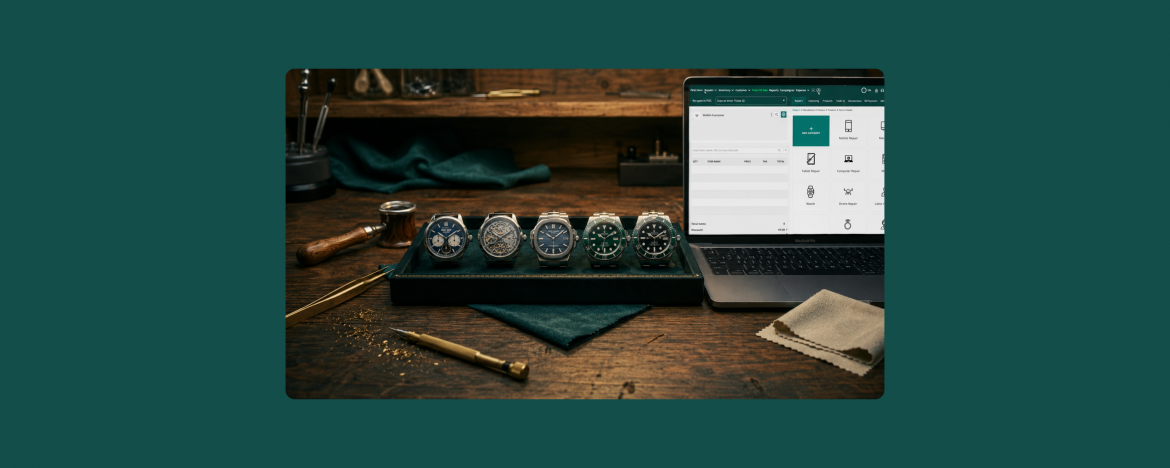
Watch repair is still one of the most demanding repair verticals in 2026. Customers walk in with $10,000 mechanical watches, and luxury brand timepieces such as Rolex, Patek Philippe, A. Lange & Söhne, Omega, Vacheron Constantin worth tens of thousands that need careful documentation at every step.
Meanwhile, luxury resellers like The RealReal and Vestiaire send batches of pre-owned watches to repair shops for refurbishment. And brands like Shinola and Filson partner with watchmakers to handle their warranty repairs.
If you run a watch repair shop, the work has never been more valuable, but also more demanding. Every piece has a serial number. Every repair has a warranty, and each returning customer expects you to remember what you did last time.
This blog walks through what business owners need from their watch repair shop software in 2026. We will also cover how RepairDesk handles the things that make watch repair different from every other repair vertical.
The Watch Repair Business Has Changed
Watch repair shops used to serve walk-in customers with battery replacements and basic services. That work still exists. But the high-value side of the business has grown fast.
Three things are pushing this market:
Luxury Watches are Lasting Longer
A well-maintained Rolex, Omega, or Patek Philippe is now treated as a family heirloom. Customers take extra care of these watches and get them serviced properly, not just fixed.
Resellers and Luxury Brands need Refurbishment Partners
Companies like The RealReal, Watchfinder, and Crown & Caliber send shipments of pre-owned watches to repair shops for service before resale.
Brand Partnerships are Growing
Brands like Shinola and Filson contract local watchmakers to handle their warranty repairs. One contract can mean dozens of watches a month.
The watch repair shops that grow are the ones that can serve walk-in customers and B2B accounts as well. That requires real systems, not paper repair tags.
What Makes Watch Repair a Different Business
Unlike other repair verticals where one completes 20 jobs a day, a watch repair shop may finish 5. But each one of those 5 carries more weight than 20 electronics repairs combined.
That’s because watch repair isn’t fast. It’s slow, careful, and built on trust. In addition, the systems that simplify electronics, cell phone, or computer repair shops will break a watch shop in three months.
Here’s why watch repair runs on its own rules:
One Job can take Days
A vintage Omega service might pass through your bench, then to a specialist for movement work, then back to you for final regulation. Three weeks of waiting. A month of parts on order. Customers are patient, but only if they get updates.
Time Pieces are Worth a lot
On average, a standard Rolex service can cost $800 to $2,000 with repairs. However, if you lost it, the watch is not a $200 replacement. It’s a $15,000 or more problem. Every watch needs a paper trail you can defend.
The same Customer comes back Every Year
Your regular customer brings the same A. Lange & Söhne in for an annual service. The same Patek for a 5-year overhaul. The same Hamilton that has been in the family for three generations. If you don’t remember what you did last year, they will, and they may find another watchmaker who does.
Every Watch has a Name
Just like computers, and smartphones have an IMEI, watches have a serial number. It lives on a brass plate inside a case that costs a lot. Logging it wrong, or worse, not logging it at all, makes warranty claims and parts ordering impossible.
Brand Partners are watching
When a luxury brand like Shinola or a reseller like Watchfinder sends you 20 watches a month, they’re not just paying for the work. They’re trusting you to track every piece. Lose one watch from a brand contract, and the contract goes with it.
Mail-in is Real Money
Watch repair customers ship from across the country. A customer in California sends a 1960s Speedmaster to a watchmaker in New York. The shop that handles that transaction well wins repeat business. The shop that loses the watch in transit loses far more than one customer.
A well equipped, and reliable mail-in repair management software can help you build your own custom repair workflow and manage the entire process stress-free.
If you’re new to watch repair or want to expand your service menu, see our guide on the common watch repairs to focus on for more business.
The 4 Things Every Watch Repair Shop Has to Track
Before picking any software, get clear on what your shop has to keep visible at all times:
Serial Numbers
Every watch coming in needs its serial number logged. This is how you identify the piece across multiple visits and how you order brand-specific parts.
Warranty Terms
Some pieces come in under brand warranty. Others come back under your own service warranty. Some are out of warranty entirely.
Repair History Per Timepiece
When a customer brings the same watch back, you should see every prior service, every part used. Without it, you’re guessing.
Parts Used
Crystals, crowns, gaskets, movements, batteries. You need to link every part used with the repair ticket.
A watch repair shop software is worth paying for if it handles, or simplifies all four. Here’s how RepairDesk does it.
How RepairDesk Tracks Serial Numbers
Every watch that comes in is a unique asset with its own identity. RepairDesk treats it that way.
- Customer Assets Linked to Tickets: You can log every watch against a customer profile. Brand, model, serial number, pictures at intake, condition notes.
- Searchable by Serial Number: You can pull up any ticket by typing the serial number. No guessing which customer it belonged to.
How RepairDesk Manages Warranty Tracking
Watch repair shops lose money on paper-based systems. RepairDesk solves it in three ways.
- Warranty Terms at Intake: Set the warranty period right when you create the ticket. 6 months, 1 year, 2 years, lifetime, whatever your shop offers. The system tracks the expiration date automatically.
- Custom Warranty Fields: For luxury brand partnerships, set custom warranty terms per service type.
This protects you in disputes. It also gives customers a clear record of what’s covered and what’s not.
Mail-in and B2B Watch Repair
The biggest growth area in watch repair is mail-in and B2B. Customers shipping watches from out of state. Luxury resellers sending refurbishment batches. Brands like Shinola and Filson contracting local watchmakers.
Mail-in Workflow with ShipStation
RepairDesk’s built-in mail-in workflow with ShipStation handles shipping, label printing, and order tracking. Customers fill out a form on your website, ship the watch, and get status updates the whole way through.
B2B Customer Portal
For luxury resellers, brand partners, and other commercial clients, RepairDesk includes a B2B customer portal. They can submit batch orders, check status on multiple watches at once, view notes, and pay invoices online. No more email back and forth.
Account-Based Invoicing
B2B accounts don’t pay per watch. They pay on accounts. You can bundle multiple jobs onto a single monthly invoice using invoicing software for repair shops. Cleaner for them. Faster for you.
Batch Order Handling
Receive a shipment of 10 watches from a reseller. Create one batch ticket. Track each piece individually within that batch. Send one invoice when the work is done.
A Real Workflow Inside RepairDesk
Here’s what a typical watch repair job looks like from intake to pickup:
- Intake: Customer drops off a Grand Seiko for full service. The front desk creates a ticket, logs the serial number, and takes pre-repair images of the watch.
- Diagnostic: Your watchmaker inspects the movement, documents findings, sets status to “Quote Pending.” RepairDesk sends the customer an SMS estimate with an “Approve” button.
- Customer Approves: Customer approves online. Status moves to “In Repair.” Then, you order the required parts and the ticket moves to “Waiting on Parts” if anything is on backorder.
- Repair Complete: Watchmaker finishes the service, runs the post-repair check, attaches new photos to the ticket. Status moves to “Ready for Pickup.” After which, watch repair shop software automatically sends a status notification to the customer. So they know their watch is ready for pickup.
- Pickup: Customer pays through the POS. The customer leaves with a watch that has a full digital service history.
The whole workflow runs through one system. No paper. No notebooks.
Final Word
Watch repair is a high-value, high-trust business. Every timepiece that comes through your door represents money, memory, and reputation. The shops that grow are the ones that treat the data with the same care as the watches themselves.
RepairDesk’s software for watch repair shops handles the tracking, the warranties, the customer history, and the B2B workflows. All in one platform. With free onboarding and a team that knows repair shops.
Ready to see how it works for your shop?
FAQs
1. Do I Manage the Warranty of Watches Separately in my Watch Repair Store?
No. RepairDesk allows you to enter warranty information for all services and parts. You can easily define the claim, history, duration, and conditions within the POS. If your customer comes with a claim, simply track it through the repair ticket or use the watch repair shop barcode tracking.
2. Can RepairDesk’s Watch Repair Shop Inventory System Manage all my Watch Store Inventory?
Yes. With RepairDesk, you can create both serialized and non-serialized inventory and assign labels to all of them. If you ever need to find an item, you can track it by searching for the product name or the unique SKU.