

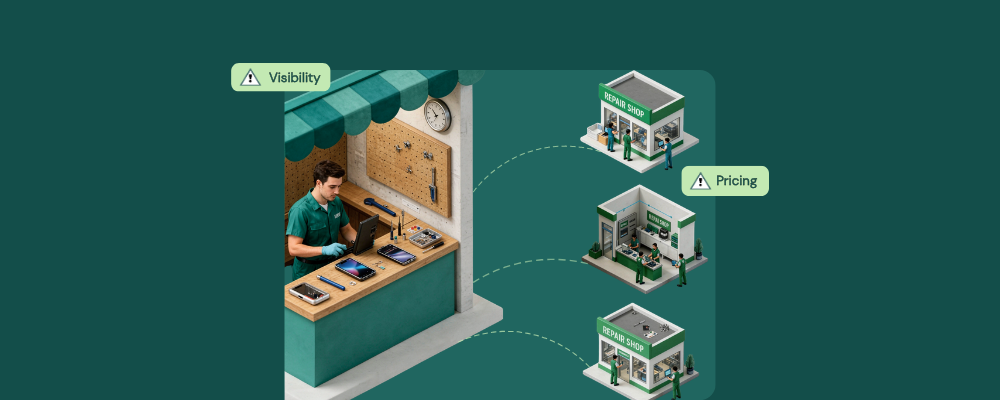
Scaling from one repair shop to three looks like growth, but it often feels like confusion. What used to work through memory, quick hallway chats, and the owner catching issues in real time starts slipping through cracks.
The first signs are subtle. A ticket goes quiet. A part gets ordered twice. Two locations quote different prices for the same job. Suddenly, you are spending more time untangling than leading.
This is where multi-location repair shop software earns its keep. With the right repair shop software, you can standardize how tickets move, how parts are tracked, and how teams communicate so expansion stays controlled.
The 8 Breakpoints You’ll Hit First When You Add Locations
As you add locations, the cracks usually do not show up in one dramatic moment. They show up as small inconsistencies that stack up across tickets, parts, pricing, and people. If you catch them early, scaling feels controlled and repeatable. Here are the eight breakpoints most shops hit first, and what they look like in real life.
1) The First Thing that Breaks is Visibility
At one location, visibility happens naturally. You can overhear the counter, see what is waiting on parts, and catch a stalled ticket before it becomes a problem. At three locations, that instinct disappears and work starts hiding in separate queues, separate habits, and separate updates. This is where multi-location repair shop software becomes essential because it gives you one consistent way to track what is in progress, what is blocked, and what is ready across every shop.
The stabilizer is standardization. Define the same statuses, require the same intake fields, and review the same daily queue at each branch. When your team follows one workflow, repair shop workflow management stops relying on memory and starts running on repeatable processes.
2) Pricing Consistency Breaks Next
Pricing drift shows up fast once you have more than one counter and more than one location. One shop starts quoting a little higher, another gets comfortable discounting to close faster, and soon customers compare notes. Margin loss usually doesn’t show up with a bang. It creeps in, little by little, and before you know it, your team is bargaining at the counter instead of sticking to a consistent pricing playbook. And the longer that pattern runs, the tougher it is to tighten things back up without upsetting loyal customers who’ve gotten used to the wiggle room.
The way out is to put the rules in one place and take the uncertainty off the table. Build a single master service menu, set clear discount caps based on job role, and define exactly when a manager approval is required for edge cases. Then standardize the fundamentals across every location such as diagnostics, labor rates, and your most common add ons so estimates stay consistent regardless of who is working that shift. Done well, repair shop pricing consistency improves and your team stops reinventing pricing at the counter.
3) Inventory Control Breaks When Parts Move Between Locations
Inventory usually breaks quietly, then all at once. A tech borrows a part from another branch, someone forgets to log it, and counts stop matching reality. You reorder what you already have, then still get stuck mid repair because the right part is sitting on the wrong shelf. Transfers become casual favors instead of trackable movements, and turnaround times start slipping without an obvious cause.
To stabilize this fast, treat every part movement like it matters. Tie parts to their respective tickets, note down transfers as real stock changes, and set location minimums according to demand. Standardize item names so the same part does not get repeated under different labels. Once you do that, repair shop inventory management becomes predictable again and purchasing stops feeling like constant damage control.
4) Communication Breaks Between Front Desk and Technicians
When you add locations, communication breaks because each counter starts capturing details in its own style. One branch writes clean notes, another keeps them vague, and technicians waste time clarifying what the customer actually meant. Updates get inconsistent, and customers feel like they are getting a different story depending on who they speak to. With multi-location repair shop software, the goal is to make every ticket follow the same intake structure so technicians always get the details they need without chasing.
Solve it with clear standards that remove ambiguity. Stick to one intake checklist, make required fields non negotiable like the problem details and device condition, and store photos in the same spot every single time. Create a handoff routine for technicians so they may notice gaps and ask for missing details before getting to work. That is how front desk and tech communication stays tight as the team scales.
5) Accountability Breaks When Roles Stay Fuzzy
At one shop, ownership feels obvious because everyone is close to the work. At three locations, tasks fall into the gray zone. Approvals wait, callbacks get missed, parts do not get ordered on time, and escalations sit because nobody is clearly responsible. Managers end up acting like messengers instead of owners, and the team starts blaming the system when the real issue is unclear responsibility.
The solution is straightforward, but it needs discipline. Set clear owners for approvals, parts ordering, QA checks, refunds, and customer follow ups at every location. Document what done means for common situations so people stop improvising. When expectations are written and repeatable, repair shop SOPs stop being a nice idea and start protecting your operation.
6) Customer Experience Breaks
Customers can handle a delay, but they struggle with inconsistency. One location promises a turnaround time another location cannot match. One branch charges diagnostics upfront, another waives it casually. Warranty language changes depending on who is working, and customers start feeling like the rules are flexible in the worst way. That is when trust drops and reviews start mentioning confusion more than the repair itself.
This matters because people leave after bad experiences. In PwC’s 2025 Customer Experience Survey, 52% of consumers said they stopped using or buying from a brand because of a bad experience. Unify policies for diagnostics, deposits, warranty, refunds, and pickup expectations, and make updates follow a consistent rhythm so repair shop status updates feel reliable everywhere.
7) Reporting Breaks and Decisions Get Emotional
Once you hit multiple locations, reporting breaks because everyone is tracking the business differently. One manager counts the backlog one way, another uses a different definition, and suddenly your numbers do not match your reality. That is when decisions turn into debates, and you start managing by instinct instead of facts. With multi-location repair shop software, the goal is one source of truth so you can compare locations cleanly and spot issues early.
Start with a small weekly scorecard and keep the same definitions everywhere. Track backlog, turnaround time, close rate, revenue per ticket, and comebacks, then review it on a fixed cadence. When data is consistent, conversations get calmer and action becomes obvious. A solid repair shop reporting dashboard makes problems visible before customers feel them.
8) Hiring and Training Breaks the Culture
The third location usually exposes the biggest risk, which is uneven training. New hires learn local habits instead of company standards, so quality varies by branch. One shop becomes known for messy tickets, missed steps, or shaky customer updates, and your strongest people burn energy compensating for gaps. Over time, the culture fragments into three different ways of doing the same work.
To prevent that, make training repeatable and measurable. Build a simple week one onboarding plan, tie it to real tasks like intake quality, ticket updates, and QA checks, and keep short checklists for the most common repairs. You can also support consistency by using AI to standardize team output so every location follows the same playbook. Reinforce the same expectations in every branch through coaching and review. When you do that, repair shop staff training scales the culture instead of diluting it.
How RepairDesk Helps You Scale Without Losing Control
When a repair shop grows from one location to three, the real problem is not volume. It is variation. Each branch develops its own way of creating tickets, quoting prices, moving parts, and updating customers.
That variation makes small mistakes repeatable, and it creates blind spots where issues sit until they become complaints, refunds, or rework. What used to be corrected quickly in one shop starts compounding across multiple teams and counters.
RepairDesk fixes this by giving you one connected system to standardize how work runs across locations.
With RepairDesk, ticket flow stays consistent, strengthening repair shop workflow management across locations. Intake details, photos, and updates also stay in one place, which improves front desk technician communication. Shared pricing rules and controlled overrides protect repair shop pricing consistency, while tying parts to jobs and tracking movement between branches strengthens repair shop inventory management. Finally, a dependable repair shop reporting dashboard gives you one set of numbers so decisions are based on reality, not guesswork.
Conclusion
Scaling from one repair shop to three does not break because you suddenly got busier. It breaks when each location starts running the same work in slightly different ways, and those small differences compound into delays, rework, and inconsistent customer experiences.
If you standardize visibility, pricing, inventory, communication, accountability, customer policies, reporting, and training early, growth stays controlled instead of chaotic. With multi-location repair shop software supporting those standards, you stop relying on memory and constant check ins, and you start running a repeatable operation that can expand with confidence.
FAQs
Q1. What is the hardest part of scaling a repair shop to multiple locations?
Consistency. If each location runs tickets, pricing, parts, and updates differently, small issues repeat and become bigger problems fast.
Q2. When should a repair shop start standardizing processes for growth?
Before opening the second location. Standards are easiest to set when you are not already managing multiple habits.
Q4. How do you keep pricing consistent across multiple repair shop locations?
Use one master service list, clear discount limits, and approval rules for overrides. Remove “personal pricing” at the counter.
Q5. How do you manage parts transfers between repair shop locations?
Track transfers like real inventory movements and tie parts usage to tickets. Avoid informal borrowing that never gets recorded.
Q6. What metrics should multi location repair shops track weekly?
Backlog, turnaround time, close rate, revenue per ticket, and comebacks. Keep definitions identical across locations.


