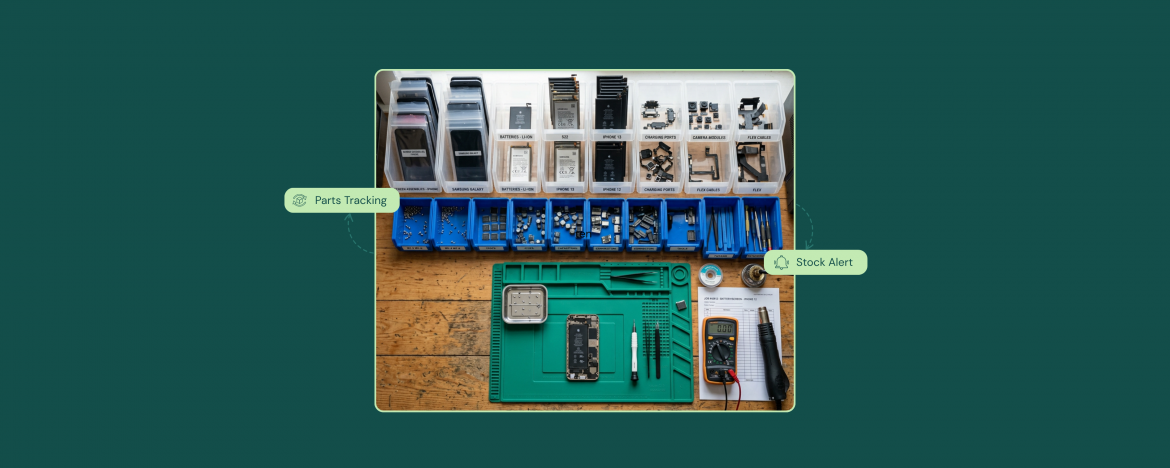
Picture this: you order 20 iPhone 16 screens at the start of the month. Two weeks later, they’re gone. Not sold, but scattered across tickets, handed off between techs, and now you’re sitting there wondering how a month’s worth of inventory disappeared. You didn’t see it coming. You couldn’t have. Because nobody was actually tracking it.
This isn’t a hypothetical. It’s the reality one repair shop owner shared in a recent conversation with us, and it’s the same story playing out in repair businesses everywhere.
The truth is, not tracking your repair parts and accessories is silently killing your business and you don’t realize it until you sit down and add up what poor visibility is actually costing you.
In a recent conversation with repair shop owners, parts and inventory tracking came up as the top pain point. Not pricing. Not competition. Parts tracking.
If you’re running on spreadsheets, paper, or a system that wasn’t built for repair, you’re almost certainly losing money you can’t see.
Let’s break down where it’s going.
Why Repair Parts Tracking Is the #1 Pain Point in Repair Shops Today
Across single-location shops and multi-store franchises, across cell phone repair, computer repair, e-bike specialists, and even power tool businesses, one theme keeps surfacing: nobody knows what they have, where it is, or when it’ll run out.
One owner put it bluntly:
Parts come in, they go on shelves, techs grab what they need. I do a physical count once a month and cry a little when I see how much money is sitting on those shelves.
Another owner of an e-bike repair business, when asked how much inventory she had in stock, answered:
I honestly have no idea. Maybe $30,000? Could be more. I order stuff when we need it and it just piles up.
This isn’t carelessness. These are smart, hardworking business owners. The problem is that the tools on which they rely, such as spreadsheets, notebooks, etc., were never designed to keep up with the speed and complexity of a real repair operation. That’s one of the major reasons why your business is losing money without an inventory management tool. Without efficient software, tracking stock becomes nearly impossible.
The Five Hidden Costs of Poor Parts Tracking
Here’s what happens when you don’t track inventory at your shop the right way.
1. Lost Sales From Phantom Stockouts
A “phantom stockout” is when you actually have the part, but you don’t know you have it, so you turn the customer away or delay the repair. For multi-location shops, this happens quite a few times.
A franchise owner running seven stores described it this way:
We had a situation last week where one store was out of iPhone 15 screens while another store had 30 sitting in a drawer. We lost sales because of that.
Every walked-away customer is real revenue lost, and worse, a reputation hit. They don’t just leave; they may go to your competitor.
2. Dead Stock Eating Your Cash Flow
Dead stock is the opposite problem: parts that have been sitting on your shelf for months because you ordered too many, or because the model became obsolete, or because nobody wants them anymore.
Cash that’s tied up in dead stock isn’t earning you anything. It’s not paying rent, neither technicians. It’s just sitting there. And without proper repair parts tracking, you have no way to know how much of your “inventory value” is actually money you’ll never get back.
So, you must find a solution to prevent the dead stock at your repair shop.
3. Panic Ordering and Margin Erosion
When you can’t see what you have, you over-correct. You panic-order. You pay for rush shipping, and accept higher per-unit costs from secondary suppliers because your primary supplier is out. Every one of those decisions chips away at your margin.
A repair shop running on healthy margins can be quietly brought to its knees by months of unnecessary expedited shipping fees and emergency reorders, none of which would happen if the owner had real visibility.
4. Wasted Technician Hours
Your technicians are your highest-value labor. Every minute they spend hunting for a part, walking to another shelf, asking a coworker if they’ve seen the last panel, or doing manual stock counts is a minute they’re not repairing devices.
One owner described her Sunday-night routine:
I export everything to Excel and spend my Sunday nights making pivot tables. It’s ridiculous.
That’s not just lost time, that’s owner burnout, the kind that quietly drives people out of the business they built.
5. Customer Trust and Review Damage
This is the cost most owners never connect back to parts tracking, but it’s real. When you don’t have the part, you are unable to complete jobs on time. When the repair gets delayed, the customer doesn’t hear from you. And when they don’t hear from you, they assume you’ve forgotten them, and they leave a review that costs you every future customer who reads it.
One shop owner shared the math:
We probably lose 5–10 customers a month because they think we forgot about them. They write angry reviews and take their device somewhere else.
Multiply that by the lifetime value of a customer and the number is staggering. However, ups and downs are part of life and as a business owner, you must know how to respond to negative reviews.
Why Spreadsheets and Paper Systems Always Break
Spreadsheets are fine for a side hustle. They fall apart the moment you have more than one technician, more than one customer at a time, or more than one part flowing through your shop in a day.
In our recent conversation with shop owners, many were still on manual systems: spreadsheets, paper, whiteboards, even sticky notes. Every single one of them mentioned losing track of parts as a daily problem. The system isn’t just inefficient. It’s actively hiding the cost of running your business from you.
The Multi-Location Problem: When Bad Tracking Compounds
If parts tracking is hard at one location, it’s even tough if you own multiple repair stores. A multi-location computer repair owner described it this way:
We lose track of parts all the time because of manual transfers. Last month we thought we were out of RAM modules at location A but we actually had 20 sitting at location B.
For multi-location owners, the cost of poor parts tracking isn’t additive, it’s multiplicative. You’re not just losing one customer at one store. You’re losing them across every location, every day, while inventory sits in the wrong place. Centralized, real-time visibility isn’t a nice-to-have for these shops. It’s the difference between a chain that scales and one that quietly collapses under its own weight.
What Good Repair Parts Tracking Actually Looks Like
A proper and efficient inventory management software does a few things that spreadsheets and paper simply can’t:
It updates in real time. Every time, you use a part and attach it to a ticket, your stock count drops automatically. So, no need for manual logging.
It notifies you before you run out. Set a low-stock threshold, and the software informs you when it’s time to reorder, before a customer is standing at your counter waiting.
It connects to your suppliers. Reorders that used to take hours of manual data entry happen in clicks. One franchise owner noted that his managers were spending hours every week just manually updating stock after orders came in.
It gives you visibility across locations. If a part exists in your network, you know where it is. Inventory transfer between locations becomes a few clicks instead of a phone tree.
This is what repair parts tracking should look like.
Calculating Your Own Hidden Cost (Quick Self-Audit)
Before you do anything else, sit down and answer these five questions honestly:
How many times in the last month did a technician say “we’re out” of a part you actually had somewhere in your shop or network?
How much of your current inventory has been sitting unsold for more than 90 days?
Also, how many customers left negative reviews because of a parts-related delay?
Whatever number you came up with, it’s probably an underestimate. The hidden cost of poor parts tracking is, by definition, hidden, until you start measuring it.
From Reactive to Proactive: The ROI of Real Parts Tracking
The shift from spreadsheets to real repair parts tracking isn’t just an upgrade. It’s a fundamental change in how your business runs.
When parts tracking works, ordering becomes predictive instead of reactive. Margins stop bleeding from emergency shipping. Technicians stop hunting and start fixing. Customers get their devices back faster, leave better reviews, and come back the next time something breaks.
Final Words
Every day you run your shop without proper repair parts tracking is a day you’re paying a hidden tax. Lost sales, dead stock, rush shipping, wasted hours, bad reviews, none of it shows up on a single invoice, but all of it adds up.
The repair shop owners who win in the next five years will not be the ones with the cheapest parts or the fanciest storefronts. They will be the ones who can see their business clearly and make decisions based on data instead of guesses
Start using repair shop software to simplify and manage inventory effectively and track parts so that you can serve every customer in a timely manner.
FAQs
1. Can I Track Repair Parts using a Spreadsheet?
You can, but spreadsheets break down quickly. They don’t update in real time, don’t connect to your point-of-sale, and rely on humans manually logging every change. The moment you have multiple technicians or more than a handful of parts moving each day, spreadsheets start hiding more than they reveal.
Instead, you should use inventory management software for repair shops as it will help you track all the stock and notify if your inventory falls below a certain threshold.
2. What Features should I look for in Repair Parts Tracking Software?
Look for real-time stock updates, low-stock alerts, supplier integrations, multi-location visibility, ticket-level part deduction, and reporting. Make sure the software is built for repair shops specifically.