

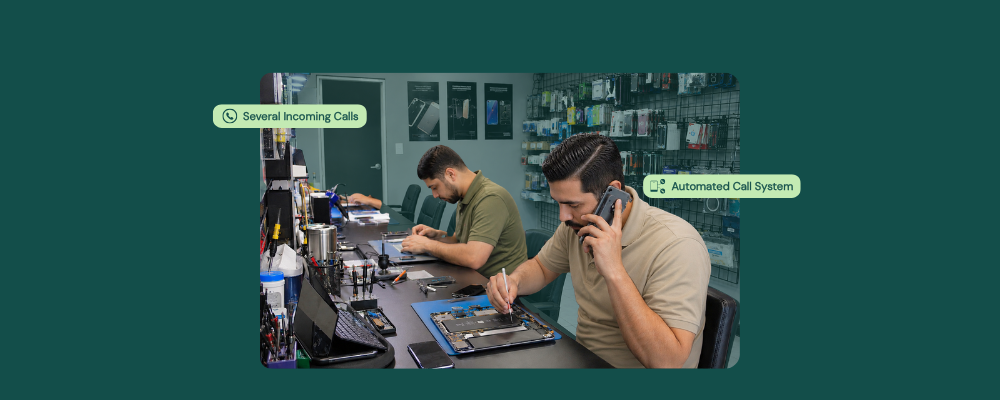
It’s 10 am on a Tuesday. Your front desk staff member is on the phone. A customer wants to know if their phone is ready. Right behind them, a walk-in customer is waiting. The technician just finished a repair and needs the next ticket to keep going. In the midst of all this activity, the phone rings again, even before the first call ended.
Now, the issue is not a staffing problem, nor does it require you to hire more people to answer the phone. What you need is to automate customer updates in your repair business using RepairDesk.
Let’s have a look at the math that several repair shop owners never calculate and end up silently suffering for not looking into it.
The Math Several Repair Store Owners are Unaware of
Here is a simple example of how the cost of your technician spending two hours on the phone ultimately becomes too much to handle.
A repair shop loses a full hour to 20 three-minute calls every day. If we add follow-up calls for part delays (5 calls of 4 minutes, which equals 20 minutes), pickup reminders that staff manually dial out (5 calls of 3 minutes = 15 minutes), and review requests managed by hand (also 15 minutes), the total time on calls is approximately 110 minutes.
That’s over 2 hours every day!
The technicians at your repair store will spend over two hours on the phone instead of serving walk-in customers, processing repair tickets, or handling device intake. At a standard labor rate of $18/hour, these two hours of daily manual phone calls will cost over $9000 annually, a cost that can be easily eliminated with automated customer update software.
Why Do the “Is It Ready” Calls Keep Coming?
Now that we’ve had a look at the hidden costs, let’s see why such calls keep bugging your store. There is only one reason for that.
The customer has no way to be informed about their repair. No one told them the repair moved from the stage of “diagnosed” to “in repair. ” No one told them whether the part had arrived or that their repaired device was waiting on the shelf for collection. So, naturally, they call (even excessively!)
RepairDesk understands the need for this automation and therefore sends an automated SMS notification to the customer every time the technician updates the status of a repair ticket. It sends an SMS without requiring any manual action from the technician. The customer receives the update, reads it within 10 seconds, and relaxes.
The call? It never happens!
The Most Damaging Call, aka Parts Delay
Whenever a repair is waiting on a part, the customer doesn’t know that unless someone tells them. In a paper-based system, this information is often forgotten, forcing them to call the repair store. Each call takes a long time because technicians have to find their ticket and check the status of their part manually, and even then, the answer is often uncertain.
RepairDesk’s repair ticket management system logs a “waiting for parts” status against the repair ticket and sends an automated SMS to the customer.
Its inventory management system fires a low-stock alert as soon as SKUs reach the reorder threshold and generates a draft purchase order for the assigned supplier. This way, the delay caused by parts shortages becomes very rare.
The Pickup Reminder Your Staff Shouldn’t Be Dialing
A completed repair sitting on the shelf for collection is dead revenue. Most repair shops handle pickup reminders manually. Usually, a staff member scrolls through completed jobs, identifies them, and calls each one manually every day.
RepairDesk’s automated communication system sends a pickup reminder to the customer as soon as it’s done. It also keeps a record of the customer communication and resends the reminder if the device is uncollected after a certain period. Not only that, but it also prompts the customers to leave a Google Review, which is pertinent to your repair store.
Centralizing Communication with RepairDesk’s Phone System
One of the major issues of the delays is having a workflow that creates communication gaps between your stores. However, RepairDesk’s phone system centralizes communication, resolves queries faster, allows you to view logs of missed calls, and enables call routing after hours.
In Dawn’s words (owner of iDropped), the flexibility to tailor the Phone System to her store’s requirements helped her handle inbound calls and significantly reduce call management time.
What Fewer Inbound Calls Actually Look Like
When RepairDesk handles parts delay alerts, status updates, pickup reminders, and review requests, inbound call volume drops. The 20+ daily calls are reduced to 2-3 calls a day. The manual pickup reminder stops entirely as well. This keeps your technicians off the phone and on repairs so walk-in customers can receive better, quicker service.
Final Words
The phone will always ring. Customers will always have queries about whether their device is ready. This part will never change. However, the frequency of such calls will change. With RepairDesk, you can manage your status updates, reminders, and review requests silently and easily in the background. This way, your technicians will work more efficiently on repairs and make the most of those two hours every day.
FAQs
1. Do automated customer updates feel impersonal to customers?
Not if they are timed correctly. A customer who receives the update immediately after a change in the repair appreciates the communication. RepairDesk also allows repair shop owners to customize SMS content so that the notification includes the store’s personal details. That way, the message feels more like a personal update rather than a generic update.
2. Can I manage customer calls 24/7 in my repair store?
Yes. Use the backup AI receptionist, ARIA, by RepairDesk. It reduces missed calls, provides the store’s directions, schedules appointments, looks up repair tickets, and captures every lead.
3. What if a customer replies to the automated SMS with a query?
RepairDesk Connect captures all replies in a unified box within the POS. That way, as soon as the message is read, employees can respond on the same screen. The entire conversation is logged in RepairDesk for easy follow-up and access.


